|
|
 |
|
|

|
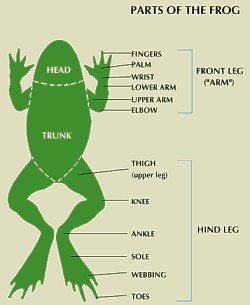
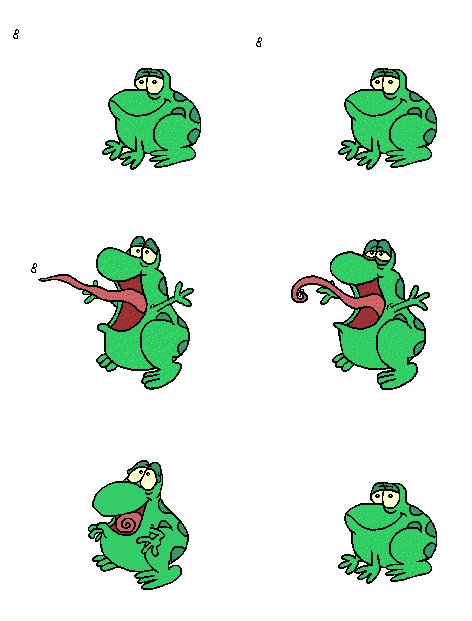
Although different species may vary in size or color, almost all frogs have the same basic body structure. They have large hind legs, short front legs, and a flat head and body with no neck. Adult frogs have no tail. Most frogs have a sticky tongue attached to the front part of the mouth. They can rapidly flip out the tongue to capture prey. Like higher animals, frogs have such internal organs as a heart, liver, lungs, and kidneys. However, some of the internal organs differ from those of higher animals. For example, although adult frogs breathe by means of lungs, they also breathe through their skin. A few burrowing species have short hind legs and cannot hop. But all other frogs have long, powerful hind legs, which they use for jumping. Frogs also use their large hind legs for swimming. Most waterdwelling species have webbed toes on their hind feet. The smaller front legs, or arms, prop a frog up when it sits. The front legs also help break the animal's fall when it jumps. Frogs that live in trees have tiny, sticky pads on the ends of their fingers and toes. The pads help the animal cling to the tree trunk as it climbs. Most frogs have thin, moist skin. Many species have poison glands in their skin. The poison oozes onto the skin and helps protect the frog. Some species of frogs change their skin color with changes in the humidity, light, and temperature. Frogs shed the outer layer of their skin many times a year. Frogs have fairly good eyesight, which helps them in capturing food and avoiding enemies. A frog's eyes bulge out, enabling the animal to see in almost all directions. Frogs can close their eyes by pulling the eyeballs deeper into their sockets. This action closes the upper and lower eyelids. Most frogs have a disk of skin behind each eye. Each disk is called a tympanum, or eardrum. Sound waves cause the eardrums to vibrate. The vibrations travel to the inner ear, which is connected by nerves to the hearing centers of the brain. Most frogs have a delicate sense of touch. It is particularly well developed in species that live in water. The tongue and mouth have many taste buds, and frogs often spit out bad-tasting food. The sense of smell varies among species. Frogs that hunt mostly at night or that live underground have the best sense of smell.
|